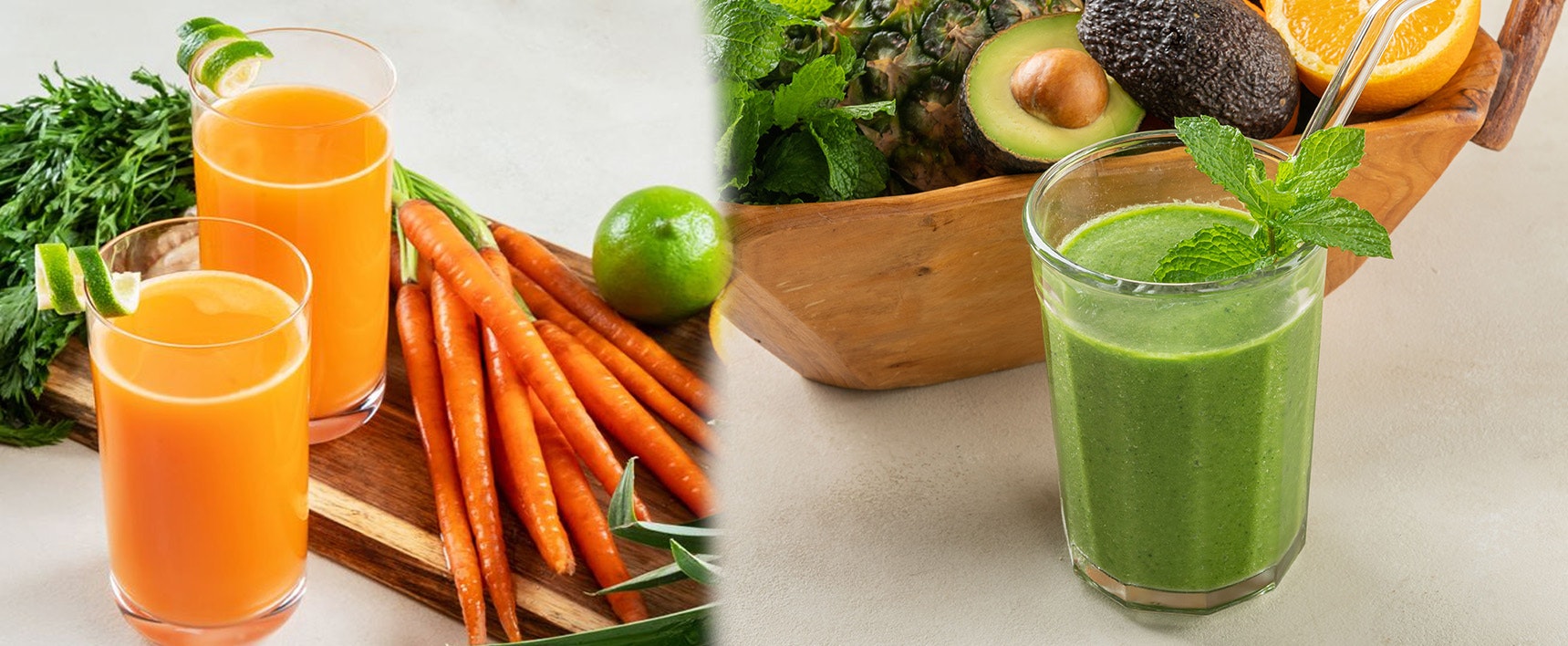
Let’s talk about a controversial subject: juicing vs blending.
I've always found the juice vs smoothie debate to be strange for two reasons:
- Consuming raw fruits and vegetables is good regardless of how they are consumed, so neither juicing or making smoothies is "bad".
- Many people still think blending actually is the same thing as juicing.
So, first of all, let's set the record straight: juicing is not the same as making a smoothie.
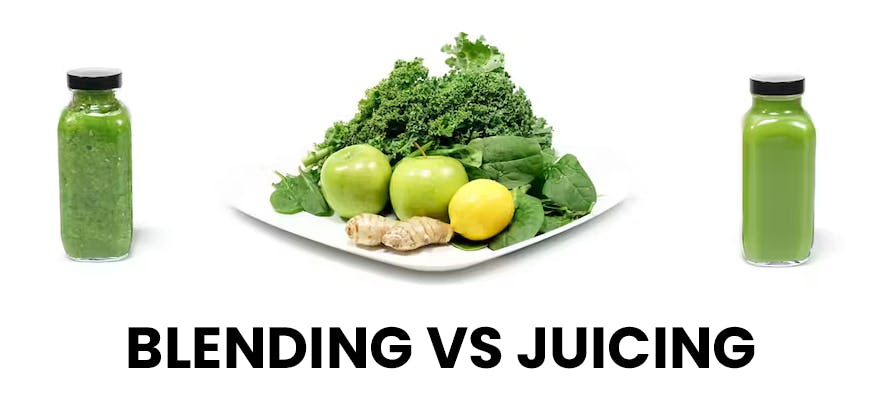
What is juicing? Juicing is the process of extracting the water from plants, leaving out the insoluble fiber like the skin, seeds, and flesh of the fruit. A real cold-press juicer like a Goodnature creates juice that contains less than 1% solids.
What is blending? Blending (i.e. making a smoothie) is the process of grinding up the fruit and vegetables in a blender (including all the skin / flesh / etc.) to make a smoothie. A smoothie also almost always contains extra liquid, since liquid is required to assist the blending process. This liquid is usually non-dairy milk, coconut water, or other liquid.
Neither is strictly "better" than the other -- it all depends on your goals.
That's why I'm going to go over the key health differences between juicing and blending in this article. I'll also bust some myths about juicing.
By the end, you'll be well-equipped to decide which is the right option for you (spoiler: it might be both).
But first, a quick story.
Questions about juicing?
Ask Goodnature and get an answer in seconds.
The Anti-Juicing Uber Driver
The Uber driver that picked me up from LAX a few weeks ago was a friendly middle-aged woman with a big smile and a positive outlook on life. She started chatting up a storm about her ideas for a holistic healing center, including a sensory deprivation tank with a lazy river.
I zoned out for a few minutes with imagery in my head of a bunch of lifeless looking bodies bouncing around a lazy river when she interrupted—”So, what do you do for a living?”
I explained that I own a company that manufactures cold-pressed juice equipment. Her attitude immediately turned from cheerful to serious, and she stated, “Well, I don’t know why anyone would want to throw away all that fiber. My Vitamix doesn’t make any waste.”
I replied “Smoothies are great too!” Then silence. She was done talking, and didn’t want to hear what I had to say on the matter. She turned up the music and we sat in the busy LA traffic for the remainder of the trip to Venice. When I exited, I wished her good luck on her venture. She didn’t even pretend to get out to help me with my luggage.
I wish I could say this attitude isn’t typical, but the truth is many people like to take sides on the matter.
Let’s go ahead and look at the differences between juice and smoothies.
Juicing vs Blending: What's the Difference & Which is Better?
Whether you choose to juice or make a smoothie depends on what your goals are.
If your goal is consume as much nutrient-dense juice as possible, juicing is certainly the way to go. Since most of the insoluble fiber has been remove, you can actually consume more raw produce than if you were consuming the full plant.
Additionally, it's easier for your body to absorb the nutrients since it doesn't have to process the fiber. Basically, the nutrients are absorbed much faster and more easily into your blood stream, which is why cold-pressed juice is often prescribed as part of a holistic healing regimen like Gerson therapy for cancer patients.
If your goal is a healthy meal replacement, it's probably best to drink a smoothie. The insoluble fiber will keep you full longer, and depending on which liquid is added, you may get the added benefit of natural fats, protein, or other nutrients. As far as the nutrients from the fruits and vegetables, it's basically the same except for the fact you're getting more fiber.
Busting Common Myths About Juicing
Some people (see: my Los Angeles Uber driver) have been led to believe some misinformation about juicing. Let's bust 3 common juicing myths.
Myth 1: Juicing is higher in sugar
If you are looking at just the fruit and vegetables alone, it's not possible for juicing to be higher in sugar. Both drinks contain the exact same sugar content from fruits and vegetables. More often, smoothies actually contain higher sugar due to additional ingredients being added. Some ingredients that often contain a high amount of added sugar: Almond milk, oat milk, Greek yogurt, vanilla or other flavor. Sometimes the "vanilla" added to a smoothie is really just vanilla flavored sugar syrup. Tricky! And don't even get me started on smoothies with sherbet as an ingredient. Seriously?
Related article: 5 Health Benefits of Juicing
Myth 2: Juice doesn't contain enough fiber
Juice absolutely contains fiber, but it's the soluble fiber only. The insoluble fiber (skin and flesh of the fruit) is intentionally removed so your body has an easier time absorbing the other vitamins, nutrients, and enzymes. That is the entire reason juicing was invented - to remove the insoluble fiber. The truth is, even when consuming a smoothie, the insoluble fiber just passes through your digestive system anyway and offers no additional benefit. If you are getting enough fiber in your diet, you have no reason to be concerned about lack of fiber in juice.
Myth 3: Juicing creates too much waste
When people see the pulp left over after juicing, it's easy to think that we are wasting food. But, as described above, almost all of what you are discarding is the insoluble fiber. If you've ever tried to taste the pulp left over after juicing, it doesn't taste like much. That's because all of the good stuff has been extracted in the form of juice already.
Is Blending Better Than Juicing?
There’s no wrong way to eat raw fruit and vegetables.
Consuming raw plants is the closest you can get to getting energy directly from the sun. When it comes to juice vs smoothies, the debate should be turned away from “Which is better?” into “Which do I need right now?” Everyone is different, including our dietary needs and lifestyles.
Personally I love having a mostly fruit (and some greens) smoothie for breakfast, and cold-pressed juice after my workout or later in the day. I don’t know why exactly, but my body tells me to do it that way. It might be that after 12+ hours of no calorie intake that’s what my body needs. It might just be because I’m hungry.
Either way, it feels better to me and as long as what I’m ingesting into my body is made from raw fruit and vegetables, any way I do it is fine!
Do you agree or disagree? Let me know in the comments!

About The Author
Charlie Wettlaufer
President and CMO - Goodnature Host - Cold Pressed Truth and Goodnature Radio Creator - JuiceCon
I’ve been around juicing all my life. My Dad built his first hydraulic juice press in 1976 and founded the company Goodnature Products, Inc. I have incredible memories of having “cider parties” when we would invite all the people in our rural neighborhood over to make apple juice. To this day, when I taste apple juice made on a Goodnature press, a rush of nostalgia runs through my body. I pride myself on guiding our clients into the world of cold-pressed juice and showing them how much fun this industry can be. I love talking business, technology, and marketing. My mission is to carry on my Dad's goal - one day make Goodnature a house-hold name.
Comments
i think i would have been like your taxi driver hahah i wouldn't have, , but your writing made me laugh. i thought i felt the same way but this has opened up my thoughts. i know so many people personally who juice and they are really fit and healthy- i thought it was too much sugar and too much waste but i see the other side now... hmmmm
I love juicing and blending, but "I'll take Things That Never Happened for 500, Alex." on the Uber story

BUZZER (wrong)
Thank you for this article. It was informative, concise, and objective. I have equipment for both juicing and smoothies, but have often defaulted to smoothie because its faster to prepare for me with a Vitamix, and I believed the additional insoluble fiber was more advantageous. However, I must admit that I often liked the texture and taste of some juices better. In the future, I think I will give juices more attention that I have in the past. Thanks again.
Glad you found this article to be helpful John, happy juicing 😄
Good explain man
Good article. Thanks.
I came here after reading some of Andrew Saul's book, Doctor Yourself. He cites folks reversing advanced osteoarthritis and hand disfigurement with juicing. I drink lots of smoothies and gain real benefits from them. But I've been hearing about juicing as medicine for a long time. Concentrated natural nutrients for treating so many health issues that our severely broken health care system suggests are unfixable.
I recently read about a Doctor Ruth Harrell that was CURING retarded and Downs Syndrome(!) kids in the 1930s and '40s with diet! (Documented and ignored by the medical community.)
I don't have a juicer yet, but will probably be purchasing one soon.
I do think the article plays down the importance of fiber a bit too much, suggesting that we get don't need all the fiber we get from a smoothie. Current research says that just about no one gets enough fiber today. Fiber feeds our beneficial gut bacteria which is a big important part of our immune systems.
But there are lots of times when you need more nutrients and can't seem to get enough any other way. Leaving out the fiber temporarily sounds like a great solution. Way better than today's expensive and poisonous drugs that often only target relieving symptoms. (Turns out curing is a bad business model. Treating symptoms keeps patients coming back.)
To everyone's great health!
1ST TIME JUICER, FIRST TIME READER! Am looking for help with this venture for my wife Son and I WE purchased a Breville Elite I realize its not a Cold Press but its what we could afford so we will start there Have had it 2 days and so far my Son has left the room in terror and my wife is trying hard to swallow my very amateur cococtions!! Help!!My 19 year old Son is type 1 diabetic in great shape 6ft 1in 210 but eats terribly relying on his insulin pump The Wife is 49 6^1" and about 260 , I am 62 5^9" 215. So we all need to do someting about ourselves... Thanks for you Information and inspiration! I will keep trying
Every morning I have a Berry smoothie with flax/chia top up with water. (never yogurt or and milks) I share this with my small daughter. I don't worry so much about my sugar intake as I used to eat 3 chocolate bars a day plus full sugar soda which I don't do any more. But I do wonder how much of the smoothie a small child should have?
Hi Ally, I would say it depends on how much other sugar your child is eating as part of her diet. In general, it's hard to eat too much fruit (if fruit is your only source of sugar).
This is an interesting and logical contrast between juicing and smoothies and I will remember this to try to feel less guilty when drinking a fresh juice. I always hear some Know-it-All Nancy's dialogue about Vitamix superiority whispering in my ear. "Eye roll*
I like the "which is better for me?" approach because the texture of smoothies and fresh fruit will inspire a very strong and very real gag reflex every time from me so fresh juice is basically the only way I can get my fruit and veggies.
I wonder if some of this talk of juice having the same amount of sugar as a soda is referring to say, Langer's grape juice, Welch's, etc in the juice aisle at the grocery store because there's no doubt that they have an insane amount of sugar. I've seen children's rotten teeth in between guzzles of 'apple' juice. People rarely read all the information about something to get the entire story in it's full perspective, just enough to support their view. I would definitely challenge that very unbalanced and seemingly ignorant viewpoint.
I totally agree,
Of course juice made from concentrate is high in sugar, it's made from syrup!
I think when most people compare fruit juice to sodas they are thinking about the "Juicy Juice" highly processed and refined juices you get from the grocery store shelf. In those, I would agree that you might as well drink soda. I think it is very important to understand the difference between cold-pressed, natural juices and commercially processed varieties. I've never seen anyone healed of disease or cancer from either soda or commercial juice. There is a huge difference.
Yes I agree!
Another cancer Victor here. Prostate Gleason 4+3 crushed at home. Organic cold pressed juice was main component of success. Replace Cut, Burn,Poison with Juice, Rest, Detox.
Thanks to Charlie and everyone for sharing.
Well siad, I don't even understand why one will compare a soda with freshly juiced raw vegetables. People alays tend to go overboared with with their comparison, also, i think people are always looking for ways to revert to their dirty habits and bad lfesyles.
Surely all that cold pressed juice helps you have muscles strong enough to lift your own luggage. When has a woman uber driver had to help some dude with his bag?.
Whether if it's a woman or a man, they usually offer to help and I just grab it myself. It's the thought that counts 😄
Excellent blog post, thank you. Something else that sets juicing apart from blending is nutrient density. I have heard that a juice delivers around 1:2.5 the nutrition compared to a smoothie, which is at best a 1:1 nutrient value, or less if water was added. That said, I agree that both juices and smoothies have their place in a healthy diet.
I believe that for sure, since once you take the flesh out of a plant, you are left with about the same nutrients in less volume–hence more nutrient density in juice.
I started my juice business in 2005. My first juicers were Nutrifaster N-450. I still keep them for small and quick batches. In 2013 I bought my first cold press, an X-1, and it paid itself in the first five month. Yield improved 30% and consistency was better. I have to say though that taste and colors were identical. My point is that I have been in this business long enough to tell you that juicing is the best natural mechanism to ingest nutrients to your body. Nothing beats a good juice cleanse to get your health back in shape. My business model is based on two factors: delivery to home and offices, and exceptional quality. In addition, I am a biochemist with an MBA degree and Integrative Health Coach certification. My weight has been the same for the last 30 years and I do juicing all morning long. So, forget about the sugar from the fruits and vegetables. That the sugar that your body needs to keep it going. We also make soups, snacks, wraps, sushis and nut mylks. Every 100% natural vegan. Check my website lifeblends.net for more details. And Charlie, your articles are worth sharing. Keep on writing my friend. Awesome!
Thanks Rafael, I appreciate the feedback. Happy to hear the X-1 has helped you with your success. I checked out your website, looks like you sell nice products. Keep up the good work!
Thanks for the information Charlie. I'm thoroughly convinced in the virtues of drinking raw juices. I've been juicing for one and a half years now and on average about 12-15 hours per week for up to 50 people[so far]! While I'm am adverse to juice diets because your getting no fibre I'm strongly in favour of adding a couple of glasses of juice per day on to your normal diet because your already getting your fibre. Ive seen a wide range of health problems fixed and getting fixed from drinking raw juices every day! I personally think roughly 80% vegetables and 20% fruit. I only use apples and lemons in fruit but I use Root Ginger and Celery to mask the heavies like Kale, Beetroot with stems and leaves ,Parsley, Broccoli, Red Cabbage, Pak choy and carrot leaves. I'm looking at buying a second hand X-1 to speed me up a lot. It looks like a great machine! Thanks again Charlie!
Sounds like a good plan. Let us know how it goes
What you describe as smoothies are relatively healthy. However, what many juice bars - including one that 'jams', pushes sugary milkshakes and merely calls them "smoothies."
There needs to be a new/updated lexicon, or purveyors of milkshakes-as-smoothies need to be called out.
There are milkshakes called smoothies, and then there are smoothies.
Totally agree. Once they get done adding all the dairy and sweetener / syrups its really just a dessert.
Hello everyone!
Charlie - I sincerely appreciate the insight you share throughout these blogs.
It's been my understanding that heat generated through blending destroys nutritional value -- and thus renders the smoothie radically inferior to cold-pressed juice. Please add definition / correction.
Thank you! - Jeff
Thats a good point to consider and one I probably should have touched on in the article.
I still have yet to see any data showing that heat created in a blender is affecting the nutrients. It really doesnt get much warmer, especially if there’s ice or frozen fruit in it, unless you run the blender for a long time.
I do think the nutrients break down faster over time vs cold-pressed juice. We ran a similar study looking at centrifugal vs cold pressed and there were definitely more nutrients in the cold pressed. However, the testing was done 24 hours after the juice was made since we had to send it to a lab.
See more info here: cold pressed vs centrifugal
Hello Charlie I would like to say that your X1 juicer is amazing we use it at our cold pressed juice bar by the way we do smoothies with all natural ingredients and we use raw almond milk or oat milk with fresh fruits and Frozen fruits as well. Honestly there's no reason why you have to choose between the two sometimes you feel like juicing sometimes you feel like a smoothie sometimes you feel like an acai Bowl it's all about having variety. Next time you're in the Venice or LA area visit us at howling juice we are in Culver City
Thanks John, I'll let you know next time I'm in the area!
Hi Charlie,
Great article of comparison. I say exactly of what you described in addition to bio assimilation to be more specific. I had 5 malignant tumor in my colon and did 9mos of juicing with Norwalk juicer and followed Gerson diet & therapy. The time I went to the hospital they told me they will do a colostomy on my while taking the tumor. A couple hours they rolled me out of the OR and said they couldn't find any of the tumor. I tell this story all the time and explain the difference of the smoothie and cold press juice. I would like to open a juice bar and like to have your latest machine. Do you offer financing program?
That's an amazing story! We may be able to help with financing. I will have someone reach out to you.
HI Charlie! SO happy for you - that your tumor is gone!!! Have you read about Radical Remissions??? The lady who started it, has gone around the world, recording stories, about people like you, who have overcome cancer, surviving against all odds. Amazing & uplifting stories! She would love to hear your story, if you haven’t already been in touch with her.
Great post! Thank you for continuing to share your knowledge with all of us. Comparing fresh pressed juice to cola is ludicrous. 😄
I’ve often wondered which was better but the end result always came back to which is best for me. I make a green smoothie every morning Mon-Fri with my Vitamix. This is very convenient for me due to how quickly I can toss everything into the blender and it’s my breakfast. Yes, there can be a ton of sugar in smoothies BUT it’s natural sugar & you can tone down the amount of sugar when making it yourself. I typically do a 5 day Juice Cleanse twice a year and I make juice if I’m sick. I notice a huge difference in my body when I Juice vs Smoothies. I can feel the nutrients flowing through my body immediately! If juicing wasn’t so time consuming I’d Juice more often. What that being said, Charlie, I agree with you. Why choose when you can have the best of both worlds!!
Nice to hear you do regular juice cleanses, I'm starting a 5 day cleanse in a week!
I really like smoothies too but I always have to tell the cashier or person making it not to add the syrup sugar or other sweeteners into it. When you watch them make it you can see most shops and restaurants add a shot glass of sweetener.
Making it home is the safest bet.
Thank you for article, very informative.
Thanks JJ!
I have a Hurom and love it...i mostly juice veggies and some fruit... i do smoothies too. People have fruit fear and shouldnt be worried about eating it or juicing it.
Hi Charlie
I have started juicing very recently and I feel very fresh and energetic. We own dental business and we have about 16 people in our office. I would like to buy one of your machines so they can enjoy the benefit of juicing. I am looking for the machine with will not take much of employee time to operate. I am not going to make any money out of this machine but just out of love for our employees I would like to facilitate in our office. The machine that you have is very expensive and won't justify the spending for us. Can you please make something that is not so commercial and expensive.
I think a "slow juicer" like a Hurom would be good for an office. It's not cold-pressed, but it's as close as you can get without spending too much money on a juicer, or too much time making the juice. Any fresh juice is good juice!
Hi Charlie
I have been in the juice business 30 years and you write the best blogs and I enjoy reading them. You know your subject inside out. Keep up the good work. Richard
thank you Richard! That means a lot.
Fair comments but you're missing the other side of the argument — the World Heath Organisation has recently put fruit juices on the same level as Coco Cola for (lack of) health benefits, specifically for it's high sugar content (for the body, sugar is sugar is sugar and too much is always bad). I see the juicing trend currently taking the world and I'm considering your X1 mini for our startup cafe & restaurant, but when viewed with the increasing anti-sugar trend, it seems juicing has a limited life span. Any comments?
That is a different debate. A smoothie and a juice made from the same ingredients have the same amount of sugar.
The idea that consuming raw juice can be compared to cola seems silly to me. I meet a lot of people that juice regularly, and I can tell you for sure that they are not suffering from the health problems that people are that drink a lot of soda.
As far as the life span of juice, I can tell you with certainty that there are more people drinking natural juice now than ever before, and that will continue to increase as people become more conscious of their health.
It's so interesting to me how many people compare coke products to raw juice from fruits and vegetables. I dont understand how that would even be in the same category or sentence.
I just started my juicing biz. I'm working farmers markets and my first market was last Sunday. I had two people come up to my booth aggressively agrueing against juice and the "harmful effects it has on blood sugar."
Why aren't these people going into coke product facilities, fast food restaurants, and conventional grocery stores expressing the hazards and harm they do?! Mind blowing.
As a nutrition major and certified holistic health coach I can say all sugar isn't the same. Your body will react COMPLETELY different to a fresh glass of raw juice compared to a glass of coke.
I love juice, nutrition, and your blog... it's always spot on!
-Alexa
-The World Health Organization has taken thousands of pounds from food companies such as Coca-Cola and Nestle.
-The Pan American office has accepted $50,000 from Coca-Cola, $150,000 from Nestle and $150,000 from Unilever
-It has also been relying on the food and beverage industry for advice on how to fight obesity
Read more: http://www.dailymail.co.uk/news/article-2220194/World-Health-Organisation-taking-cash-handouts-Coca-Cola-plug-black-holes-budget.html#ixzz5EeGWpqol
Follow us: @MailOnline on Twitter | DailyMail on Facebook
I think its very important to do your research when you find or hear about these comparisons esp from large organization.. you need to know their donars to know their agenda and who's interest they will protect.
Its absurd when I hear people compare Coca Cola to drinking freshly squeezed orange juice. People are not getting sick and fat from drinking freshly squeezed or cold pressed juices. Smoothies are fun to drink if you're looking for the added protein but Ive been to loads of smoothy places that add sugar syrups and other sweeteners and have had to ask them not to.
I drink both but cold pressed juice more.. great blog Charlie!!!
Cant wait till you make an even smaller more affordable home press. 😄
There are to diffrent sugars one Sucrose which is processed cane sugar and the other is fructose they are not the same and react diffrently in the body.
I have most always blended, and I have a blender but not a juicer. However, the way juicing makes me feel is way more significant than blending. I dont know why, I only know but why I feel. And I have a really good sense of what's good for me and what isnt(and I'm not a fan of sugar). And juicing feels really good for me personally, which is strange.
Comment